Cúram Connect
Designing a smarter way to find and switch GP clinics in Ireland
An independent product initiative exploring how structured discovery can reduce friction in healthcare access.
Project Brief
An independent product initiative exploring how patients navigate fragmented healthcare systems to find and contact GP clinics. The focus is on reducing friction between intent and action in a high-stakes, real-world context.
Role & Scope
Lead Product Designer exploring healthcare discovery systems, service design flow optimisation, MVP strategy, constraint-led thinking, and early-stage product validation.
Reducing friction between patient intent and healthcare access
Fragmented discovery system
Manual search across multiple sources
- Low trust, high effort decisions
Fast path from search to contact
Search → Evaluate → Contact in one flow
- Optimised for speed, not completeness
Trusted healthcare decision layer
Verified clinic eligibility + real-time data
- Shifts from discovery to decision confidence
The Problem
Patient pain points
- Patients struggle to find GP clinics accepting new patients
- Information is fragmented across multiple sources
- Users must manually call multiple clinics to confirm eligibility
- No central trusted system for discovery
- High effort leads to drop-off before action
Core Insight
The real problem is not search — it is uncertainty at the point of decision.
Users have high intent but low confidence. They don't need better search algorithms—they need decision-grade information that builds trust and reduces cognitive load at the moment of choice.
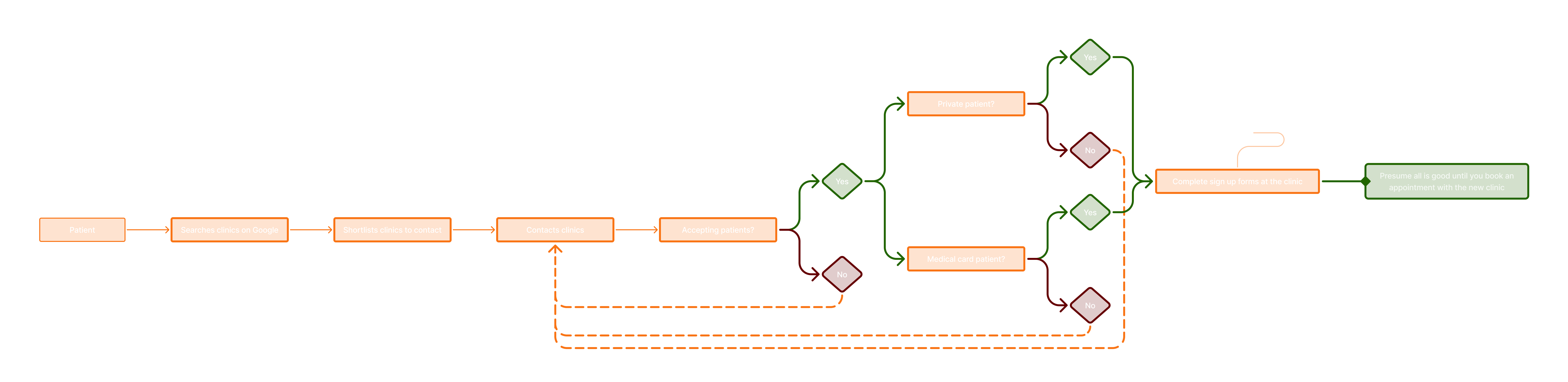
Users are forced to validate fragmented information before they can take action.
Current vs Ideal State
Current state
- Fragmented search across Google, clinic websites, directories
- Manual phone verification for each clinic
- Repeated contact attempts across multiple services
- Inconsistent information and outdated listings
- No single point of truth for clinic status
Ideal state
- Single trusted discovery interface for all clinics
- Location-based filtering with distance and availability signals
- Clear decision signals (acceptance status, availability)
- Immediate contact capability (direct call, messaging)
- Current, verified information updated in real-time
Product Strategy
Intentional Constraints
The product is deliberately constrained to a single high-value workflow: Search → Evaluate → Contact
- No booking system in MVP
- No user accounts or login
- No clinic verification layer (initially)
- No scheduling functionality
- No medical information display
Rationale
These constraints serve a critical purpose: validation of whether simplifying discovery alone improves real-world user behaviour before expanding into transactional systems.
By staying focused on a single problem, we learn what matters most and build confidence in the core value hypothesis before scaling.
User Flows & Evolution
Four states of system maturity, each validated before progression. Each iteration improves decision confidence without increasing cognitive load.
As-Is
Current System Flow
MVP Launch
MVP Flow
Maps Integration
v1.1 Flow
Long-term
Future System Vision
Key Principle
Each iteration improves decision confidence without increasing cognitive load. We expand functionality only when core assumptions about the problem are validated through real usage.
MVP Definition
This MVP is designed to validate whether reducing discovery friction alone increases meaningful user action.
User Story
As a patient, I want to search for clinics in my area and see their contact details, so that I can start the process of switching my GP with minimal hassle.
Search Capability
- •Location input (GPS / Eircode)
- •Distance-based clinic sorting
Evaluation Signals
- •Clinic name
- •Address & distance
- •Accepting patients status
Action
- •View contact details
- •Call directly
- •Share clinic info
Core Capabilities
Discovery
The entry point that builds user confidence
- Location input (GPS or manual Eircode entry)
- Distance-based clinic sorting
- Clinic name and availability status
Evaluation
The decision-making layer
- Clinic name
- Full address
- Distance from user
- Patient acceptance status (known / unknown)
- Confidence indicators for data freshness
Action
Reducing friction to intent completion
- Direct phone call capability
- Contact details display
- Share clinic details
- Save or bookmark clinics
Analytics & Success Metrics
Framed as a product validation system. Metrics are signals of whether we're solving the right problem.
Outcome Signal
Primary Success Signal
Clinic contact clicks → Intent conversion
Engagement Signal
Behavioural Signals
Search volume, session duration, drop-off points
Adoption Signal
Product-Market Signals
Unique users, repeat visits, retention rate
Expansion Signal
Growth Signals
Share interactions, referral rate, viral coefficient
System Signal
Operational Insights
Geographic search distribution, clinic engagement patterns
Key Product Decisions
No booking system in MVP
Reduces complexity and allows validation of search+contact hypothesis before building transactional infrastructure.
No user accounts or login
Minimizes friction and removes barriers to first-time use. Patients need answers immediately.
Call-first interaction model
Reflects real user behaviour. Most patients still prefer calling clinics directly to confirm eligibility.
No assumed clinic availability data
Avoids misinformation. Unknown is better than incorrect. We only display data we can verify.
Privacy-first architecture
No user profiling, no location tracking. The system is anonymous by design.
What I Would Challenge Next
The Next Problem
The next major opportunity is verified clinic acceptance data (private vs medical card eligibility).
- Users currently call multiple clinics to confirm eligibility
- Lack of trust in listings increases friction
- Verification would significantly improve decision confidence
- Clinic eligibility systems vary widely across Ireland
Product Implications
- Clinic cards evolve into decision-grade systems
- Requires data infrastructure and verification layer
- Opens door to real-time eligibility checking
- May require clinic partnerships or data APIs
Future Vision
Cúram Connect evolves from discovery tool → decision tool → trusted healthcare coordination layer
Phase 0 (Current)
- GP discovery and contact
- Location-based search
- Patient-facing interface
Phase 1 (Expansion)
- Verified clinic acceptance data
- Real-time availability signals
- Clinic-side management portal
Phase 2+ (Long-term)
- Booking or referral workflows
- Healthcare coordination layer
- Medical record integration (where permitted)
- Multi-speciality discovery (dentists, specialists, etc.)
Closing Thoughts
This project explores whether reducing friction in healthcare discovery can meaningfully change user behaviour. Early design work suggests that simplifying the path from search to contact increases intent-driven actions, but long-term value depends on trust and data verification.
The next phase focuses on validating this in real-world conditions and evolving the system based on behavioural and operational insights.
Key Learnings
- Constraints drive clarity
- Intent beats features
- Trust is a product decision
- Service design matters